Modelling
SubD Essentials: Organic Jewelry Design
By Paula Jiménez
Already have access to this course? Sign in and this page will take you straight to your lessons.
lessons completed
What you'll learn
- Understand the basics of SubD (Subdivision Surfaces) in Rhino.
- Differentiate between NURBS, Mesh, and SubD for jewelry design.
- Create and manipulate SubD primitives (cube, sphere, cylinder, tube).
- Edit geometry using vertices, edges, and faces.
- Use Gumball and essential SubD editing tools for smooth organic shapes.
- Maintain clean topology for efficient modeling.
- Convert SubD models to NURBS for production or rendering.
- Apply learned skills to create jewelry pieces like rings, pendants, and figurative designs.
Requirements
- Basic knowledge of Rhino interface and navigation is recommended.
- No prior SubD experience required; this is an introductory course.
- RhinoArtisan installed
Who is this for
- Jewelry designers looking to explore organic modeling techniques.
- Rhino users who want to expand into SubD workflows.
- Beginners interested in 3D jewelry design for rendering or 3D printing.
- Artists or designers aiming to create sculptural, flowing jewelry forms.
What's included
- Reference images for modeling inspiration.
- Tips and workflow guides for jewelry production.
- Step-by-step exercise instructions.
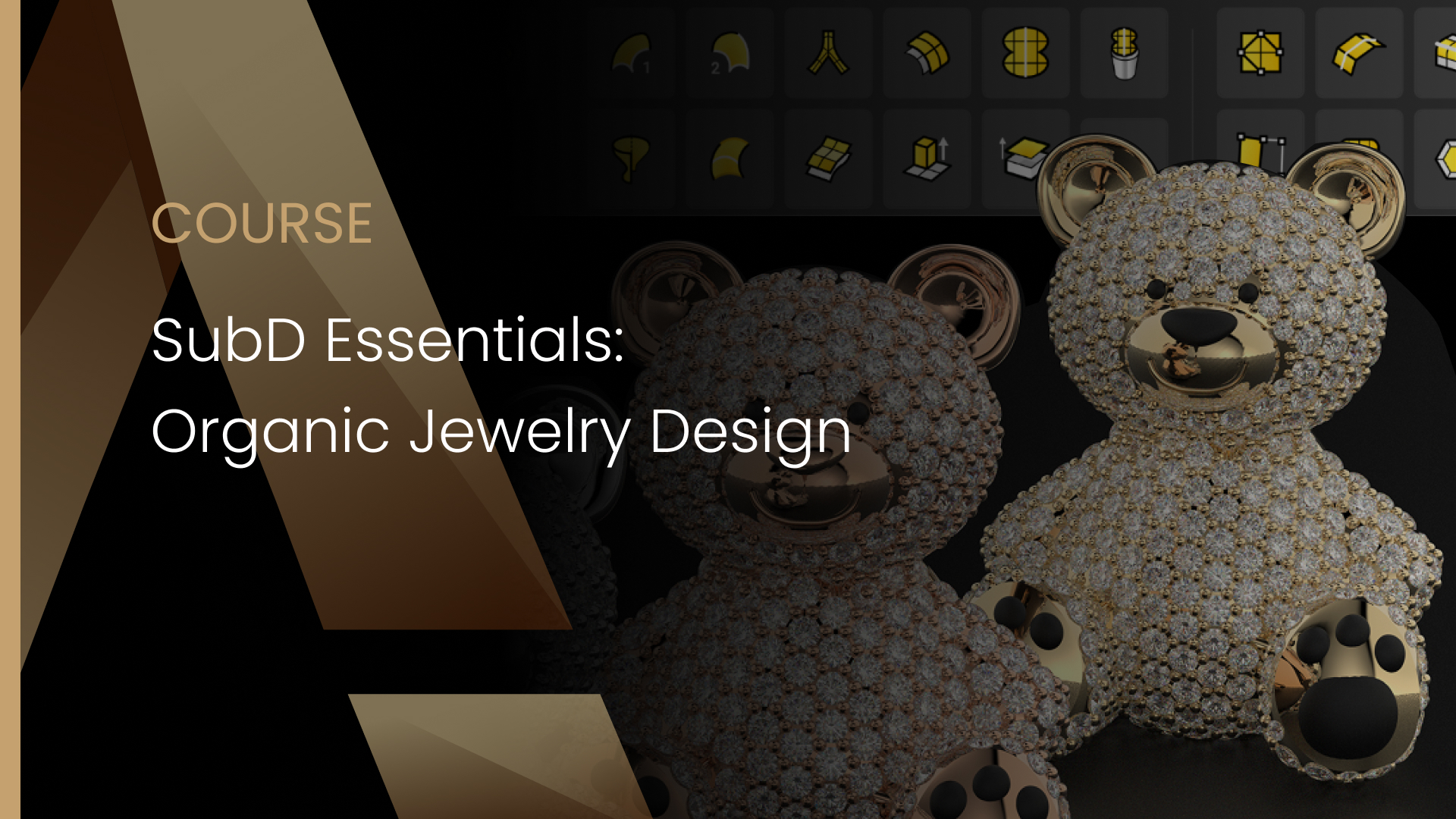
In this introductory course, you’ll learn the fundamentals of SubD modeling in Rhino, specifically tailored for jewelry design. Step by step, you will explore how to create and edit organic shapes, understand vertices, edges, and faces, and manipulate surfaces to achieve smooth, flowing forms. By the end of the course, you will be able to model stunning jewelry pieces, including a turtle pendant with diamonds and a pave teddy bear, ready for rendering or production.
Curriculum
5 topics · 16 lessons
01 SubD Fundamentals
5 lessons
SubD Fundamentals
- 01.01 Introduction to SubD
- 01.02 SubD Interface
- 01.03 Preparing Reference Images
- 01.04 SubD Blocking with Primitives
- 01.05 First Contact with SubD Editing
02 SubD Editing and Control
3 lessons
SubD Editing and Control
- 02.01 SubD Components in Depth
- 02.02 Essential Editing Tools
- 02.03 Smoothness and Flow
03 SubD Topology and Workflow
3 lessons
SubD Topology and Workflow
- 03.01 Clean Topology Principles
- 03.02 Conversion Between Types
- 03.03 Planning a SubD Model
04 Turtle Pavé Pendant
5 lessons
Turtle Pavé Pendant
- 04.01 Sculpting a Organic Turtle
- 04.02 Prepare to Pavé
- 04.03 Texture
- 04.04 Create the pendant
- 04.05 Render
05 Pavé Teddy Bear
0 lessons
Pavé Teddy Bear
Student reviews
Get this course with RhinoArtisan
Buy nowTry RhinoArtisan free for 15 days
Full access to every tool. No credit card required. Works with your existing Rhino for Windows installation.
For Rhino on Windows · On a Mac? Join the free Mac beta →
Private consultation
Bring a real project. Leave with a plan.
Thirty minutes, one-to-one, with a RhinoArtisan specialist. We look at how you work today, show where RhinoArtisan fits in your process using your own piece, and leave you with a clear next step. For jewelry professionals and workshops.
More courses

Crafting Engagement Masterpieces
Five engagement rings, modelled start to finish: a halo with a cathedral shank, a cushion solitaire, and a three-ring solitaire collection. You build the settings that define each piece — halos, baskets, peg heads, prongs and rails — then move on to helix shanks, fittings for casting and the render that sells the design. Every finished ring is saved to Curator, so you end the course with a collection ready to show clients.
Iconic Fashion Pieces
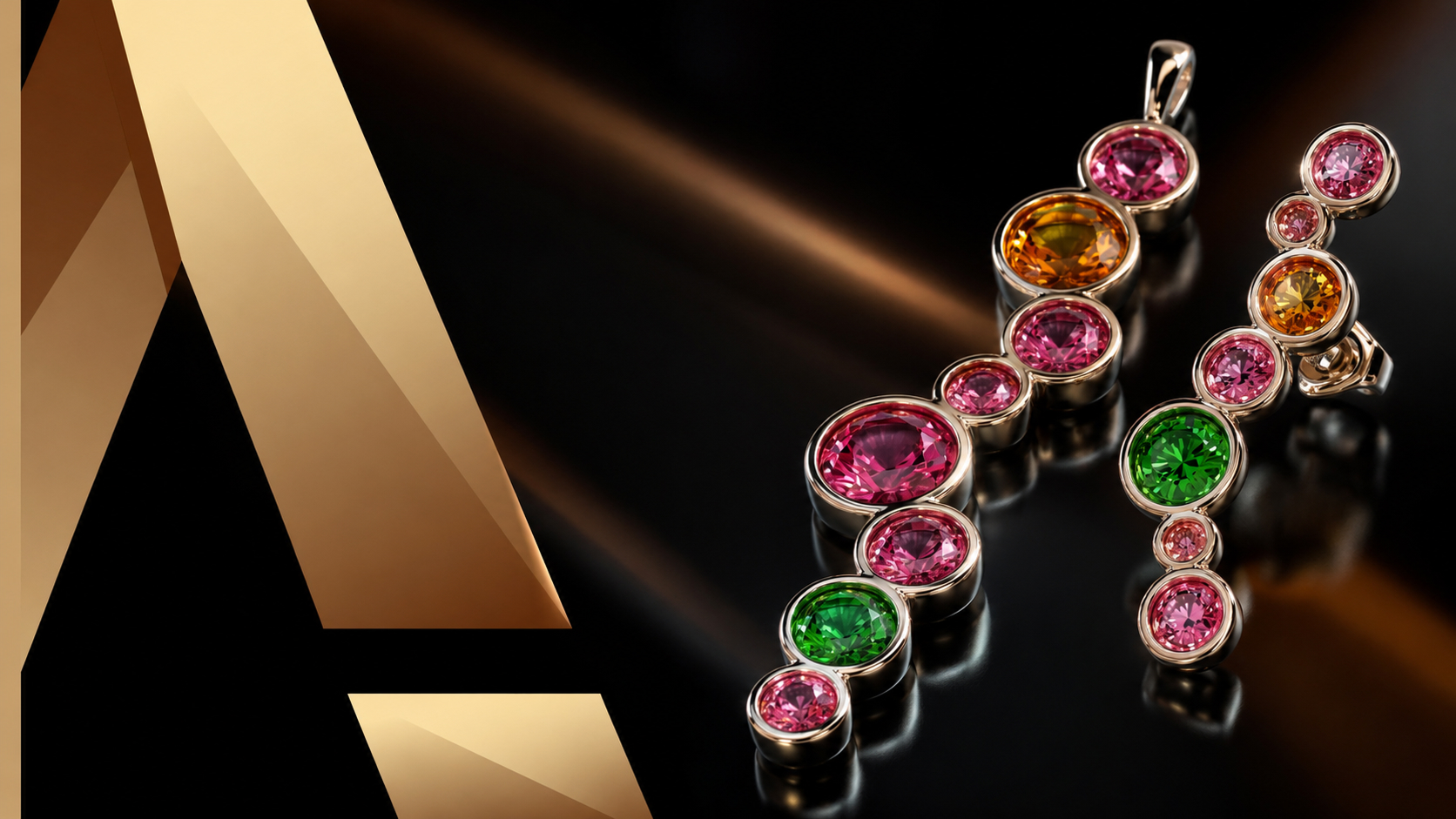
Six pieces that go beyond the classic solitaire: three statement rings — fashion, fantasy and advanced — plus a matching bezel-set pendant, earrings and ring. You work with reference images and curve patterns, Flow Along Curve, Quick Array Polar and profile-driven shanks, then stage the whole set in a single scene with cutters and materials for the final render. The result is a coordinated collection, not three unrelated rings.
Master in Jewelry Rendering in Cycles
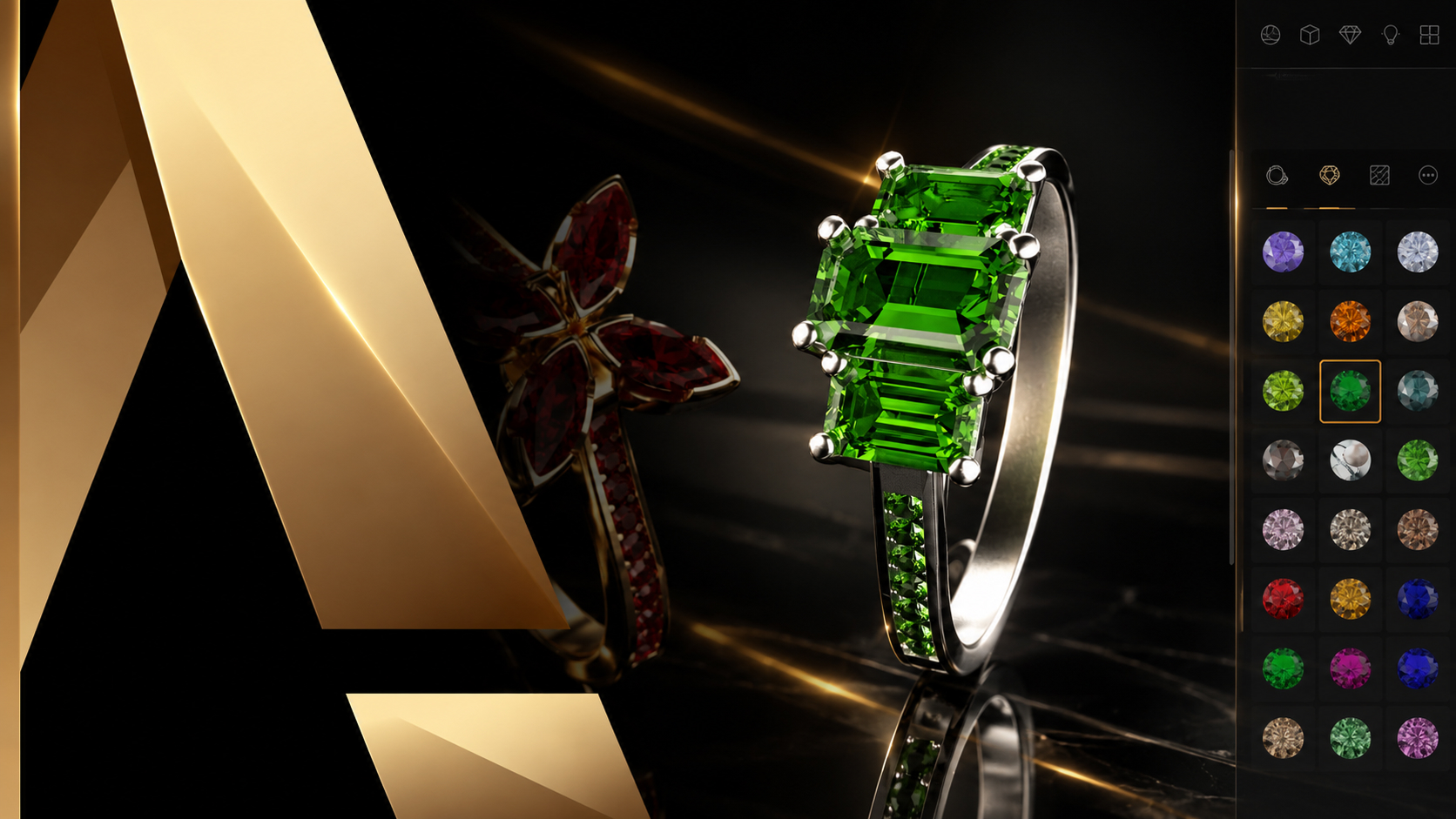
Turn finished models into images that sell. This course walks the whole Cycles pipeline inside RhinoArtisan: organising a model by layers and outliner, the difference between design and render materials, posing pieces on the ground and in pairs, building and editing environments, and the render settings behind resolution, quality and post effects. It closes with cutters for advanced gem rendering — the detail that makes stones read as real.